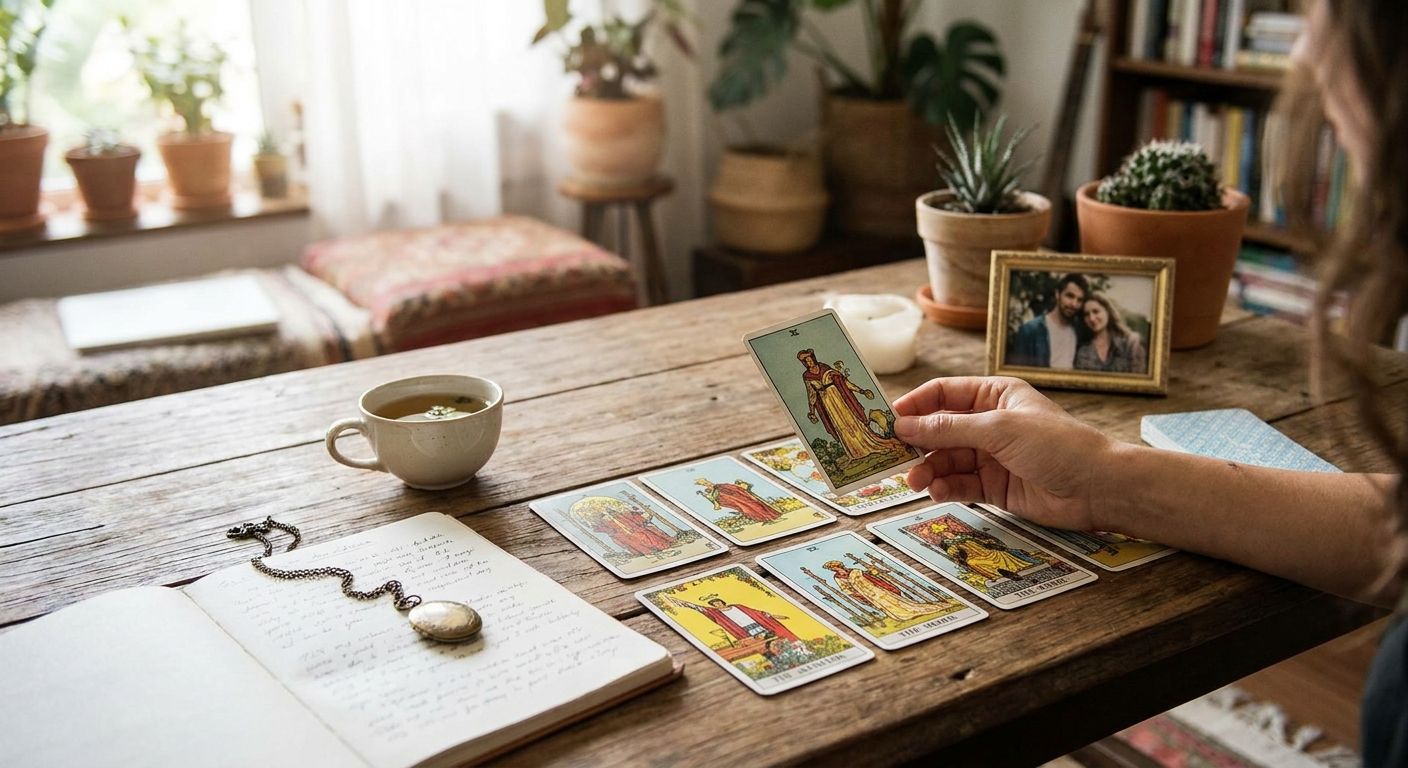
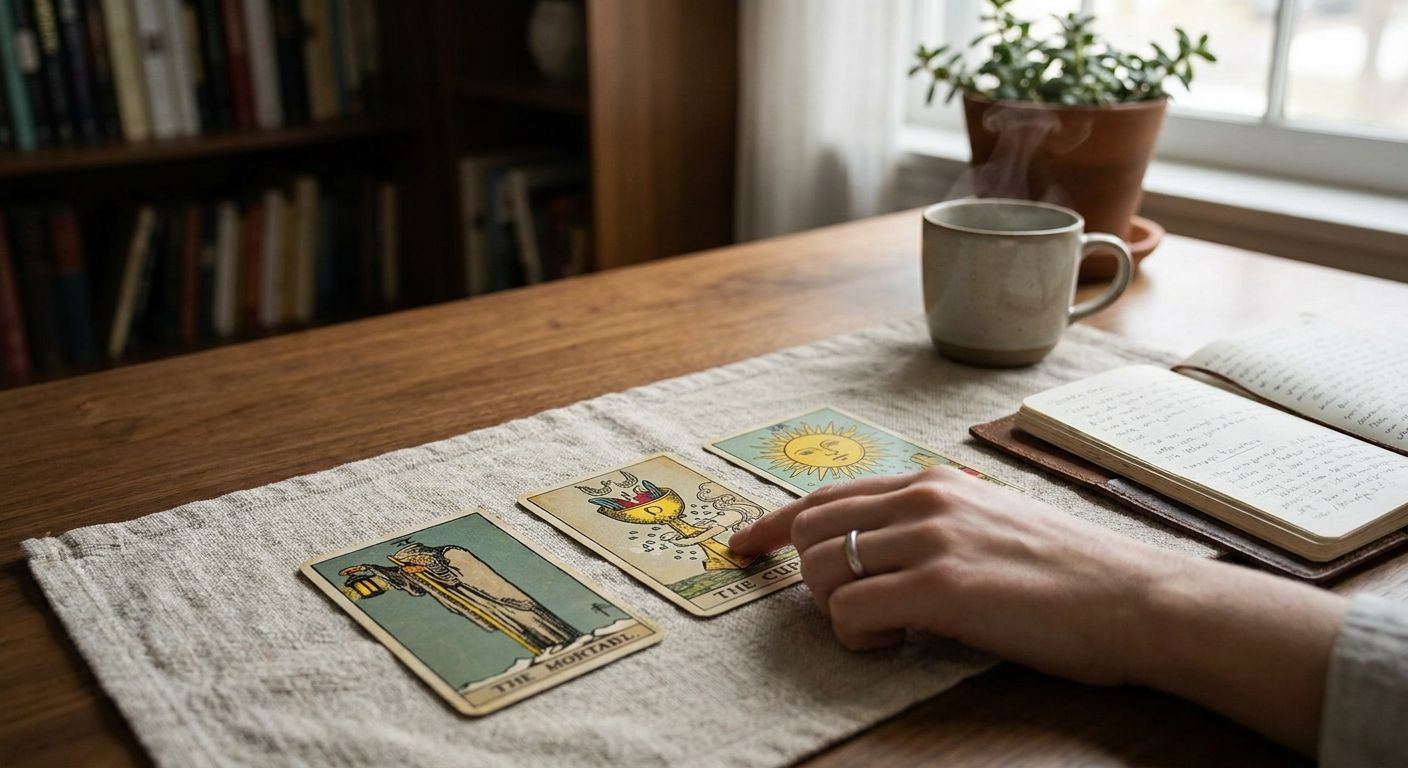
A three-card tarot spread turns a full 78-card deck into one focused answer: three cards, one story, and a clear next move for love, career, or any decision sitting in front of you.
- A three-card spread reads as one story, not three separate cards, with the middle card carrying the most weight.
- Past-present-future is the default layout, but situation-action-outcome works better for decision questions in 2026.
- Reversed cards signal delay or internal resistance, not automatic bad news.
- If the three cards feel contradictory, the question was probably too broad — reword it and pull again.
- Divine Glows offers a personalized email tarot reading by Psychic Maria when you want a second set of eyes on the spread.
Why this matters
Most people quit a three-card tarot spread at the wrong step: they name each card correctly, then never connect them into an answer. Interpretation is the whole point — a spread that just lists three keywords ('The Tower, the 4 of Cups, the Sun') tells you nothing you can act on.
In 2026, three-card spreads remain the most common layout for quick questions because they're fast to lay out and fast to read, provided you know what each position means and how the cards talk to each other. Divine Glows builds every email reading around this same principle: cards mean nothing in isolation, only in relation to the question and to each other.
What you'll need
- A full 78-card tarot deck (22 Major Arcana, 56 Minor Arcana) — any deck you're comfortable shuffling
- A quiet space with 5-10 minutes free of interruption
- A single, specific question written down before you shuffle
- A notebook or notes app to record the spread and your interpretation
- Optional: a reference sheet or app for card meanings if you're still learning the deck
If you'd rather send your question and let someone else lay the cards, wording your tarot question clearly matters just as much for an email reading as it does for a spread you pull yourself.
The steps
1. Write your question before you touch the deck
A vague question produces a vague spread. 'What should I focus on in my career this month?' gives you three cards to interpret against a specific timeframe; 'What's going to happen?' gives you nothing to anchor the reading to. Write the question on paper or in your notes app — this single step fixes most bad three-card readings before they start. Common mistake: changing the question mid-shuffle because the cards 'feel wrong' for the original ask.
2. Choose your layout before shuffling
Decide whether you're reading past-present-future, situation-action-outcome, or mind-body-spirit. Past-present-future suits questions about a pattern ('why do I keep attracting this?'); situation-action-outcome suits decisions ('should I take this job?'). Locking the layout in advance stops you from retrofitting meaning after the cards are already down.
3. Shuffle with the question in mind and cut the deck
Shuffle for as long as feels natural — there's no fixed count that matters — while holding the question in your head. Cut the deck once, then draw the top three cards and lay them left to right in the order drawn. Common mistake: shuffling on autopilot while thinking about something else entirely; the cards you draw reflect where your attention was.
4. Read card one on its own first
Name the card, its suit or arcana, and whether it's upright or reversed before connecting it to anything else. In a past-present-future layout, this card explains the root cause or the influence that got you here. Read it as a complete sentence: 'The 8 of Cups reversed says you've been circling back to something you already tried to leave.'
5. Read card two as the core of the question
This is the anchor card — it usually carries the most weight because it bridges what came before it and what follows. In situation-action-outcome layouts, this is the action you're actually being asked to take, not just a description of your current mood. Give it its own full sentence before moving to card three.
6. Read card three as direction, not prophecy
The final position shows where things are heading if nothing changes, not a locked outcome. A three-card tarot spread describes momentum, and momentum shifts the moment you change a decision. Common mistake: treating the third card as fixed fate and using it as an excuse not to act.
7. Connect all three into a single narrative
Read the spread out loud as one sentence that uses all three cards: 'You've been holding onto old comfort (card one), you're being asked to set a boundary now (card two), and doing so opens a genuinely new phase (card three).' If you can't build one coherent sentence, the individual card meanings are probably too literal — step back and use the emotional tone of each card instead of the textbook definition.
8. Write down the spread and revisit it in a week
Record the three cards, the layout you used, and your interpretation. Three-card readings often make more sense in hindsight once events catch up to the cards — checking back in seven to ten days tells you whether your read was accurate or whether you missed the real message.
“If you can't summarize a three-card spread in one sentence, you're reading the cards, not the story.”
Troubleshooting
The three cards seem to contradict each other. This usually means the question was too broad — a spread about 'my whole relationship' will pull cards addressing different sub-issues at once. Narrow the question to one specific angle and re-pull.
You keep pulling Major Arcana cards in every reading. Major Arcana cards point to bigger life themes rather than daily events; if three out of three cards are Major Arcana, treat the spread as commentary on a long-term pattern, not a single week's events.
Reversed cards confuse the whole reading. Read reversed cards as delayed, blocked, or internalized versions of the upright meaning — a reversed 10 of Cups isn't 'bad happiness,' it's happiness you haven't let yourself feel yet.
The spread technically answers the question but feels flat or obvious. That's a sign the question was already answered before you shuffled — the cards are confirming what you already knew rather than revealing anything new, and that's still a valid, usable answer.
You drew a spread for a yes/no question and got three unrelated cards. Three-card spreads aren't built for binary answers; reframe the question as 'what should I consider about X' instead of 'will X happen.'
Tools and resources
- A dedicated tarot journal or notes app folder to track spreads over time
- A card-meaning reference (book or app) until the 78 meanings feel automatic
- How to prepare for your first email psychic reading if you want to compare a self-read spread against a professional read of the same question
- A quiet 10-minute window, ideally the same time of day each time you practice
Want a second read on your spread?
Send your question to Psychic Maria and get a personalized email tarot reading.
What to do next
Once the mechanics of a three-card spread feel automatic, the next skill is asking better questions — the layout only works as well as the question behind it. If love and relationships are what's pulling you toward the cards, tarot for love and relationship guidance walks through the specific spreads and questions that hold up best for that topic.
FAQ
What does a three-card tarot spread mean?
A three-card tarot spread assigns each card a position — commonly past, present, and future — and the meaning comes from reading all three as one connected story rather than three separate answers. The middle card usually carries the most weight since it bridges the other two.
Is past-present-future the only three-card layout?
No, situation-action-outcome and mind-body-spirit are common alternatives for 2026 readings. Past-present-future suits pattern questions, while situation-action-outcome suits direct decisions.
Can I do a three-card tarot reading on love?
Yes, three-card spreads work well for relationship questions when the layout is set to something like you-them-relationship or past-present-future. A focused love question produces a far clearer spread than a general 'what's happening with my love life' ask.
How long does a three-card tarot reading take?
A self-read three-card spread takes 5 to 10 minutes including shuffling, drawing, and writing down your interpretation. A professional email reading takes longer since the reader is interpreting your specific written question in depth.
Do reversed cards change the meaning in a three-card spread?
Yes, a reversed card usually points to a delayed, blocked, or internalized version of its upright meaning rather than the opposite meaning. Treat reversals as a signal about timing or resistance, not automatic misfortune.
What's the difference between a three-card spread and a Celtic Cross?
A three-card spread uses three positions for a fast, focused answer, while a Celtic Cross uses ten positions to map influences, obstacles, and outcomes in far more depth. Use three cards for a single question and a Celtic Cross when the situation has multiple moving parts.
Can a psychic interpret my three-card spread better than I can?
A trained reader often catches connections between cards that a beginner misses, especially when the cards feel contradictory. That's the reasoning behind a personalized email tarot reading with Psychic Maria at Divine Glows — a second interpretation on the same three cards you pulled.
How much does an online tarot reading cost in 2026?
Pricing varies by reader and format, so check current rates directly on the site you're using before booking. Compare what's included — a full written interpretation versus a quick card list — before deciding.
One last thing
Most beginners read all three cards with equal weight, but professional readers lean on the middle card as the anchor and let the outer two cards color it. Try re-reading your last three-card spread with that hierarchy in mind — card two first, then one and three as context — and see if the story changes.