You just wrapped a personalized reading from Psychic Maria and you're staring at your own tarot deck wondering if you can do this yourself. Learning how to read your own tarot cards after a professional reading is less about memorizing 78 meanings and more about building the habit and the trust to interpret what you see.
- Learning how to read your own tarot cards after a professional reading starts with one deck, one spread, and daily journaling through 2026.
- The Rider-Waite-Smith deck is still the clearest choice for solo readers new to self-practice in 2026 -- buy it.
- Stick to a three-card pull for at least 30 days before attempting anything bigger -- skip ten-card spreads until then.
- Book a follow-up email reading with Psychic Maria when your own pulls keep contradicting each other or feel muddy.
Why this matters
A professional reading gives you a snapshot, not a subscription. Psychic Maria's insight on Divine Glows illuminates a specific moment in your love life, career, or personal growth path, but the cards keep moving after that email lands in your inbox. Self-reading between sessions closes the gap -- it lets you check in on a situation without waiting weeks for another full reading, and it deepens how much you actually absorb from the guidance you already paid for.
The risk is overcorrecting. New self-readers either freeze up and refuse to trust their own instincts, or they swing the other way and read every wobble or reversed card as a crisis. The steps below are built to keep you steady in both directions during 2026 and beyond.
What you'll need
- One tarot deck you feel comfortable holding -- Rider-Waite-Smith is the standard reference point most guides and apps are built around
- A notebook or notes app dedicated only to your pulls -- mixing this into a general journal makes patterns harder to spot
- 10-15 quiet minutes, ideally the same time of day each session
- The written summary from your last professional reading with Psychic Maria, since your solo pulls should build on that context, not replace it
- A basic spread reference -- three-card is the only one you need starting out
The steps
1. Reread your professional reading before you touch the cards
Pull up Psychic Maria's email and read it again slowly. This grounds your solo practice in language and symbols she already used, so your own pulls extend the conversation instead of starting a new, disconnected one.
Write down the three phrases or images from that reading that stuck with you most. If she mentioned a "crossroads" or a specific relationship theme, that's your anchor for the next 30 days.
Common mistake: skipping this step and pulling cards cold. Without the anchor, you'll interpret every card in isolation and miss the thread connecting your professional reading to your own practice.
2. Pick one question and word it the way a reading actually answers
Vague questions get vague cards. "Will things get better?" is too broad for a three-card pull to answer cleanly. Instead, ask something specific and forward-looking, like "What do I need to understand about my current job situation this month?"
If you're not sure how to phrase it, the same wording principles Divine Glows uses for wording a tarot question for clearer answers apply just as much to solo pulls as they do to a paid reading.
Expected outcome: a question specific enough that three cards can actually address it, rather than 78 possible interpretations.
3. Shuffle with intention, not habit
Shuffle until it feels right -- there's no fixed number of shuffles that makes a pull "correct." What matters is that you're holding your question in mind the entire time, not scrolling your phone with the deck in your other hand.
Cut the deck once with your non-dominant hand before drawing. This is a small ritual, but it separates a mindful pull from a distracted one, and that distinction shows up in how confidently you read the result.
Common mistake: rushing the shuffle because you're excited to see the cards. Slow down -- the few extra seconds change how present you are for the interpretation.
4. Draw three cards and read them as a story, not three separate facts
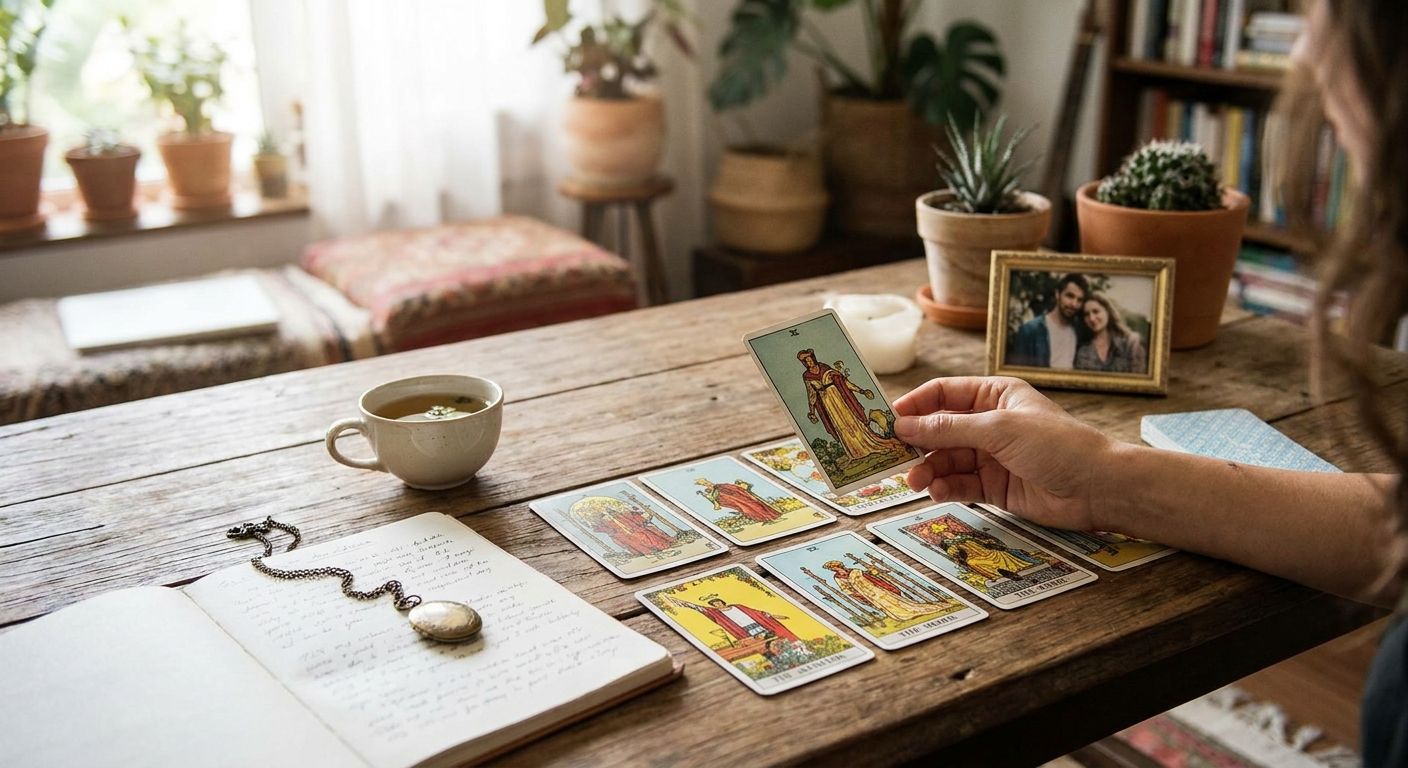
Lay them left to right: past influence, present situation, likely direction. Read card one, then card two, then ask how card two changes or confirms card one, then see where card three points.
This is the same logic behind interpreting a three-card tarot spread -- the middle card almost always carries the most weight because it reflects where you stand right now, which is usually what you actually need clarity on.
Common mistake: treating each card as an isolated fortune ('the Tower means disaster') instead of reading the sequence as a narrative that builds toward an answer.
5. Write the interpretation down before you second-guess it
Your first instinctive read is usually closer to the truth than the version you talk yourself into five minutes later. Write one sentence per card, then one sentence tying all three together, before you open a guidebook or app.
This single habit is what separates people who develop real intuition with the cards from people who just memorize keyword lists. Keep every entry dated -- by month three, you'll see which of your instincts held up.
6. Check your interpretation against a reference, not your anxiety
After you've written your gut read, cross-check the card meanings against a reliable guidebook or reputable app. Adjust your notes only if the reference genuinely clarifies something you missed -- not because a reversed card scared you into rewriting a calm interpretation into a catastrophic one.
Common mistake: letting a single ominous-sounding card (Death, the Tower, the Ten of Swords) override a otherwise clear, mild reading. These cards signal transformation and closure far more often than they signal disaster.
7. Set a re-check date instead of pulling again the next day
Give your reading room to play out. Pulling new cards daily on the same question muddies the signal and trains you to distrust your own reads. A week is usually enough space for a career or relationship question to show some movement.
If your situation is urgent -- a decision with a deadline, a yes-or-no you need fast -- that's exactly when a quick yes-or-no psychic reading from Divine Glows fills the gap your own deck can't close in time.
Troubleshooting
- Every card feels ominous no matter what you pull. You're likely reading through an anxious lens rather than a neutral one. Step away for a day and re-pull the same question once you're calmer.
- You keep getting the same card in different sessions. That's a repeating theme, not a glitch. Sit with what that specific card keeps flagging instead of reshuffling until you get something different.
- Your interpretation contradicts what Psychic Maria told you. Solo reads are a supplement, not a replacement. If the gap feels significant, book a follow-up reading rather than trying to reconcile it alone.
- You can't remember card meanings under pressure. Stick to a smaller working set of 15-20 cards you know well rather than trying to hold all 78 in your head from day one.
- The reading feels flat or the cards feel meaningless this week. That happens. Skip the session rather than forcing an interpretation -- a flat pull is information too.
Tools and resources
- A physical or well-reviewed digital Rider-Waite-Smith deck
- A dated notebook or app used only for pulls
- Divine Glows' guide on wording a tarot question for clearer answers, useful every time you sit down for a solo session
- Your most recent professional reading from Psychic Maria, kept somewhere you can reference it quickly
Not sure what your cards are telling you?
Get a personalized email tarot reading from Psychic Maria to check your own interpretation.
What to do next
Once your three-card pulls feel steady, the next stage is learning to prepare a clear, focused question before any reading -- solo or professional. Divine Glows' guide on how to prepare for your first email psychic reading walks through the same groundwork that makes both a paid reading and your own practice more accurate in 2026.
FAQ
Can I read my own tarot cards accurately after a professional reading?
Yes, most people can build accurate solo tarot reading habits within a few weeks of consistent practice in 2026. Anchoring your first sessions to a recent professional reading, like one from Psychic Maria, gives you a reference point that speeds up how quickly your interpretations start landing.
How long should I wait between a professional reading and reading my own cards?
There's no required waiting period -- you can start pulling your own cards the same day. Just keep your early solo questions tied to the theme of your professional reading rather than opening a brand-new topic immediately.
What's the best tarot deck for beginners reading on their own?
The Rider-Waite-Smith deck is the best starting point because most guidebooks, apps, and courses are built around its imagery. It's the deck most self-taught readers use as their reference throughout 2026 and it stays useful as your practice deepens.
Is a three-card spread better than a bigger spread for self-reading?
For beginners, yes -- a three-card spread is easier to interpret accurately than a Celtic Cross or ten-card layout. Save bigger spreads for after you've logged at least a month of consistent three-card pulls.
How do I know if my card interpretation is right?
Write your gut interpretation down before checking a guidebook, then track it against what actually unfolds over the following weeks. Accuracy shows up as a pattern across dated journal entries, not from a single lucky pull.
When should I book another professional reading instead of reading my own cards?
Book a follow-up reading when your solo pulls keep contradicting each other or when the situation carries real stakes, like a major career or relationship decision. Psychic Maria's email readings on Divine Glows are built for exactly that kind of deeper, focused clarity.
Do reversed cards mean something bad happened?
Not necessarily -- a reversed card usually signals blocked, delayed, or internalized energy rather than a negative outcome. Reversals in a three-card spread often just mean the theme needs more time before it plays out fully.
Can self-reading replace a professional tarot reading entirely?
No, self-reading works best as a supplement between professional sessions, not a full replacement. A professional reading brings outside perspective and years of interpretive practice that a new solo reader hasn't built yet.
One last thing
The cards you keep pulling back to back -- the ones that show up three or four times in a single month -- are usually more informative than any single dramatic-looking card. Repetition is the tarot's way of flagging what you're avoiding, and that pattern is exactly the kind of thread a follow-up reading with Psychic Maria can help you untangle once your own notes start pointing somewhere specific.